Hexybria
Stops the eggs hatching — even the ones laid after you sprayed.
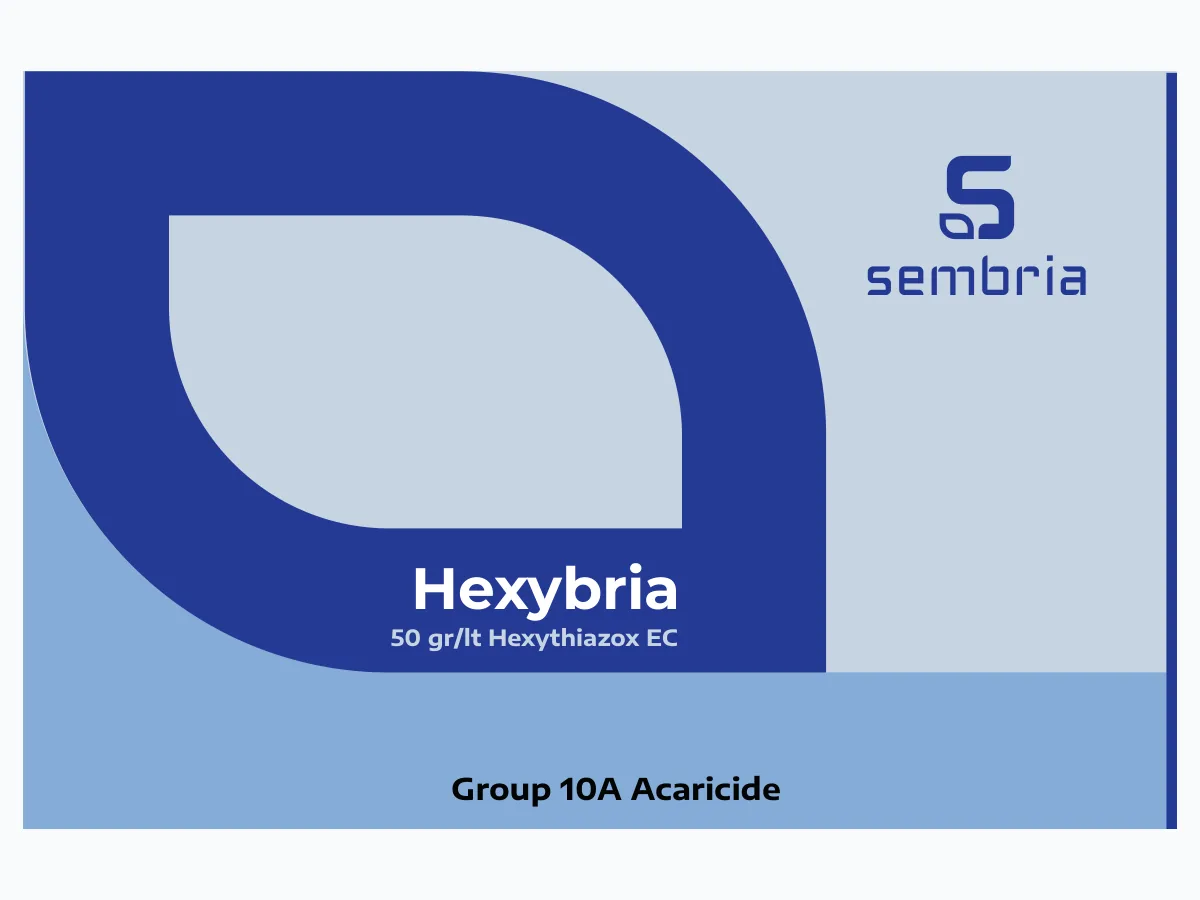
Hexybria is an ovicidal and larvicidal acaricide based on hexythiazox. It kills mite eggs, larvae and nymphs on contact, and it does something few acaricides can: an adult female that has merely walked across a treated leaf will go on to lay eggs that never hatch. That carry-over effect is why it is a preventive product, applied before adult populations build rather than after. Where adults are already numerous, tank-mix it with a contact adulticide.
Characteristics
- Ovicidal and larvicidal — controls eggs, larvae and nymphs
- Eggs laid by adults that contacted the product also fail to hatch
- Long preventive persistence from a single early application
- Registered across cotton, apple, vine and the main greenhouse vegetables
- One-day pre-harvest interval on greenhouse eggplant; three days on tomato, pepper and cucumber
- IRAC Group 10A — rotate against Group 6, 20D and 25 acaricides
How it works
Hexythiazox is a mite growth inhibitor: it disrupts chitin synthesis and embryonic development, so treated eggs never complete development and immature stages cannot moult. Activity against adults is low by design — the product removes the next generation rather than the one you can see. IRAC Group 10A.
Dosing
| Crop | Target pest | Dose | PHI (days) |
|---|---|---|---|
| Cotton | Red spider mite (Tetranychus cinnabarinus), egg, larva, nymph | 100 ml/da | - |
| Cotton | Two-spotted spider mite (Tetranychus urticae), larva, nymph | 75 ml/da | - |
| Eggplant | Two-spotted spider mite, egg, larva, nymph | 50 ml/100 L water | 1 |
| Apple | European red spider mite (Panonychus ulmi), egg, larva, nymph | 50 ml/100 L water | 7 |
| Vine | Two-spotted spider mite, egg, larva, nymph | 50 ml/100 L water | 7 |
| Tomato (greenhouse) | Two-spotted spider mite, egg, larva, nymph | 100 ml/100 L water | 3 |
| Pepper (greenhouse) | Two-spotted spider mite, egg, larva, nymph | 100 ml/100 L water | 3 |
| Cucumber (greenhouse) | Two-spotted spider mite, egg, larva, nymph | 100 ml/100 L water | 3 |
| Watermelon | Two-spotted spider mite, egg, larva, nymph | 125 ml/da | 3 |
Doses are indicative. The user is responsible for adjusting the dose to the growth stage of the crop and the conditions of the field. Apply under the guidance of an agricultural technician. Composition, method of application and dose may vary between countries for climatic, technical or legal reasons.
Application
How to apply
Cotton: assess at the 4-6 leaf stage; if the infestation is only at the field edges, treat only those areas. Treat at an average of 5 individuals per leaf in the Mediterranean zone, 10 in the Aegean and Southeast Anatolia. Vine: treat at 5-8 live individuals per leaf. Apple: from May onwards, treat at 8-10 live individuals per 100 leaves. Eggplant, greenhouse cucumber and watermelon: treat at 5 live mites per leaf; greenhouse tomato and pepper at 3. Fruit trees: make the first application after petal fall is complete. Because activity on adults is low, start before adult numbers rise — if they are already high, tank-mix an effective contact acaricide.
Compatibility
Do not mix with strongly alkaline products. Conduct a preliminary mixing test before combining with other products or foliar fertilisers. Not phytotoxic at recommended rates.
Always carry out a compatibility test before preparing a tank mixture.
Safety and handling
Flammable liquid and vapour. Harmful in contact with skin; causes skin irritation and serious eye damage. Very toxic to aquatic life with long-lasting effects. Toxic to bees, birds and fish — do not apply during flowering. Do not re-enter the treated area for 1 day. Store in a well-ventilated place, keep cool.
Read the label before use. Do not use at home. Keep away from children, food and animal feed. Use only as recommended and at the recommended dose.
Plant protection product
This page is technical information, not an offer of sale. Availability and registration status vary by territory. Always read and follow the approved product label before use.