Abamebria
Translaminar control of mites and leafminers — including the ones hiding inside the leaf.
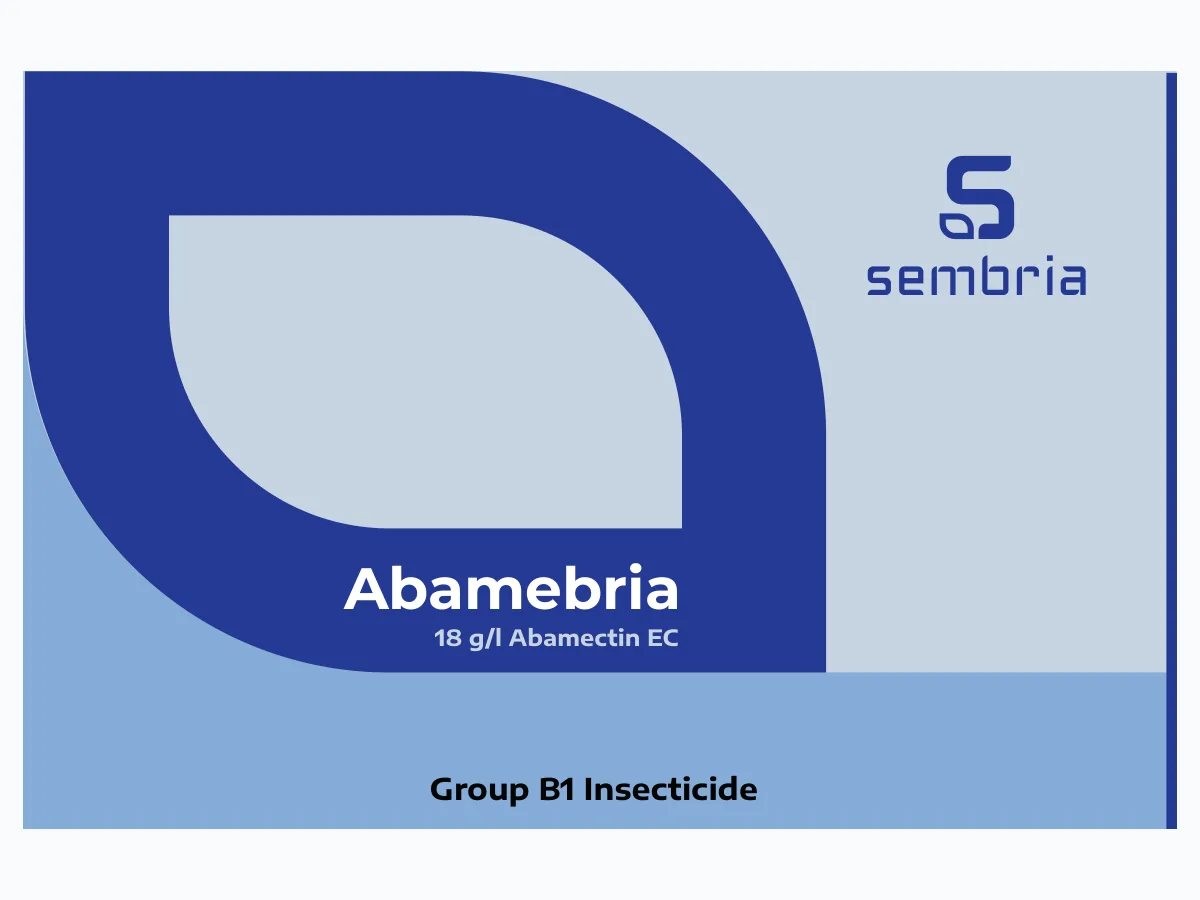
Abamebria is an insecticide-acaricide based on abamectin, a fermentation-derived active that moves into the leaf tissue rather than sitting on the surface. That translaminar movement is what makes it work on pests a contact spray cannot reach: two-spotted spider mite on the underside of the leaf, leafminer larvae tunnelling inside it, and rust mite in the folds of citrus fruit. Pests stop feeding within hours and die over the following days.
Characteristics
- Translaminar action reaches mites and miners on and inside the leaf
- Rapid cessation of feeding — visible crop protection before mortality is complete
- Broad label across citrus, cotton, greenhouse vegetables, strawberry, pear and ornamentals
- IRAC Group 6 — a distinct mode of action for rotation against Group 1, 3 and 4 resistance
- Effective at low rates; typically 25 ml/100 L of water
- Can be combined with 0.25% horticultural oil on citrus for improved coverage
How it works
Abamectin activates glutamate-gated chloride channels in the pest's nerve and muscle cells. The channels open, chloride floods in, and the cell can no longer fire. The pest is paralysed and stops feeding almost immediately; death follows over two to four days. IRAC Group 6.
Dosing
| Crop | Target pest | Dose | PHI (days) |
|---|---|---|---|
| Citrus | Olive leaf rust mite | 25 ml/100 L water | 7 |
| Ornamental plants | Leafminer | 25 ml/100 L water | Not applicable |
| Tomato | Two-spotted spider mite | 25 ml/ha | 3 |
| Cotton | Two-spotted spider mite | 50 ml/ha | 21 |
| Eggplant (greenhouse) | Two-spotted spider mite | 25 ml/100 L water | 3 |
| Cucumber (greenhouse) | Two-spotted spider mite | 25 ml/100 L water | 3 |
| Strawberry | Red spider mite | 25 ml/100 L water | 3 |
| Bell pepper (greenhouse) | Two-spotted spider mite | 25 ml/100 L water | 3 |
| Pear | Pear psyllid (nymph stage) | 75 ml/100 L water | Not applicable |
Doses are indicative. The user is responsible for adjusting the dose to the growth stage of the crop and the conditions of the field. Apply under the guidance of an agricultural technician. Composition, method of application and dose may vary between countries for climatic, technical or legal reasons.
Application
How to apply
Citrus rust mite: apply as soon as the mite is detected; good coverage is essential, use 10-20 L per tree, and it may be combined with 0.25% horticultural oil. Citrus leaf gall midge: begin when fresh shoot infestation is detected and repeat every 10-15 days. Ornamentals leafminer: begin at first symptoms, minimum 7-day interval. Tomato: spray at 3-5 live mites per leaf. Cotton: spray at 1-3 live mites per leaf. Strawberry: spray at 10 or more mites per leaflet. Pear psyllid: start from March when nymphs appear, before honeydew secretion begins.
Compatibility
Test compatibility before mixing with other products. In resistance-prone situations, alternate with products from a different mode-of-action group.
Always carry out a compatibility test before preparing a tank mixture.
Safety and handling
Highly toxic if inhaled or swallowed; causes burns; risk of serious eye damage. Very toxic to aquatic organisms. Toxic to fish and to bees — do not apply during flowering and do not contaminate water. Wear mask, protective clothing, gloves and goggles. Do not re-enter the treated area for 2 days. Flammable — keep away from fire.
Read the label before use. Do not use at home. Keep away from children, food and animal feed. Use only as recommended and at the recommended dose.
Plant protection product
This page is technical information, not an offer of sale. Availability and registration status vary by territory. Always read and follow the approved product label before use.