Indoxibria
Bioactivated inside the larva — the pest converts the product into its own poison.
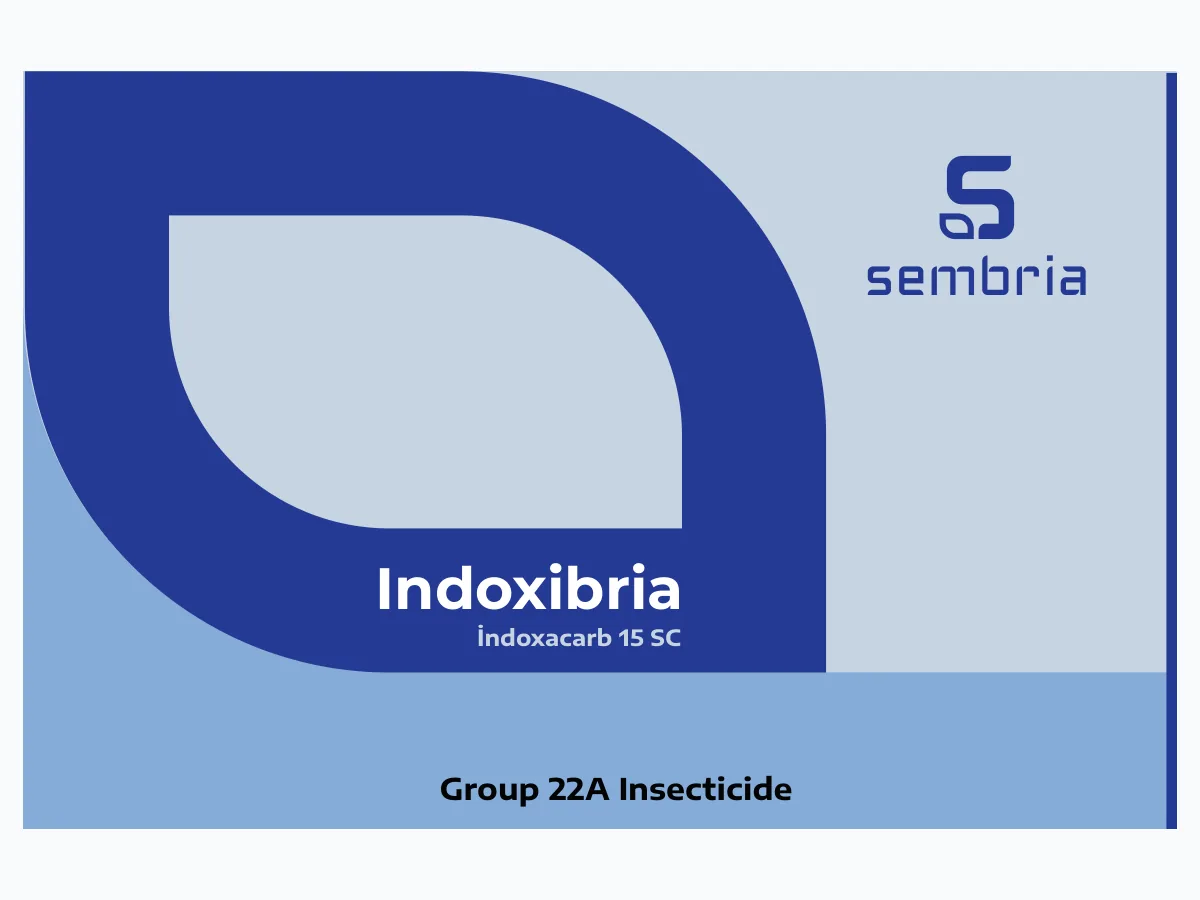
Indoxibria is an oxadiazine insecticide based on indoxacarb, and it works by a route unlike anything else in the range: the molecule applied to the crop is only weakly active, and it is the larva's own enzymes that convert it into the potent form once ingested. That bioactivation step is why it is hard on caterpillars and comparatively gentle on many beneficial insects, and why it remains effective where pyrethroid and organophosphate resistance has developed.
Characteristics
- Bioactivated by the target larva — selective toward many beneficials
- Strong on the key Lepidoptera: grape moth, codling moth, cotton bollworm, corn borer
- IRAC Group 22A — no cross-resistance with Groups 1B, 3A, 4A or 28
- Feeding stops rapidly; larvae become paralysed and drop from the plant
- Registered on grapevine, cotton, hazelnut, apple, tomato and corn
- Low rates: 25-45 ml/ha or 25-35 ml/100 L water
How it works
Once inside the larva, esterase and amidase enzymes remove a carbomethoxy group and convert indoxacarb into its active metabolite. That metabolite blocks the voltage-gated sodium channel in the closed state — the opposite of how pyrethroids act — so the nerve cannot fire at all. Feeding ceases, the larva becomes paralysed and dies. IRAC Group 22A.
Dosing
| Crop | Target pest | Dose | PHI (days) |
|---|---|---|---|
| Grapevine | Grape moth (Lobesia botrana) | 45 ml/ha | 3 (table grapes) / 10 (wine grapes) |
| Cotton | Cotton leafworm (Spodoptera littoralis), larvae | 40 ml/ha | 14 |
| Cotton | Cotton bollworm (Helicoverpa armigera), larvae | 45 ml/ha | 14 |
| Hazelnut | Hazelnut weevil (Curculio nucum), adult | 40 ml/ha | 14 |
| Apple | Codling moth (Cydia pomonella), larvae | 25 ml/100 L water | 14 |
| Tomato | Tomato fruitworm (Helicoverpa armigera), larvae | 35 ml/100 L water | 3 |
| Tomato | Tomato leafworm (Spodoptera littoralis) | 35 ml/100 L water | 3 |
| Corn | Corn stalk borer (Sesamia spp.), larvae | 30 ml/ha | 3 |
| Corn | European corn borer (Ostrinia nubilalis), larvae | 30 ml/ha | 3 |
Doses are indicative. The user is responsible for adjusting the dose to the growth stage of the crop and the conditions of the field. Apply under the guidance of an agricultural technician. Composition, method of application and dose may vary between countries for climatic, technical or legal reasons.
Application
How to apply
Grapevine: time by the prediction-warning system — apply when trap catches peak and begin to decline, at effective temperature sums of 120, 520 and 1047 day-degrees for the first, second and third generations, with the vine at bud, bunch-closure and onset-of-ripening respectively. One application per generation. Cotton bollworm: treat at an average of 2 larvae per 3 m of row. Cotton leafworm: examine 25 plants including leaves, squares, flowers and bolls; treat at 0.5 larvae per plant or 2 egg masses per 25 plants. Apple codling moth: keep trees protected through each larval emergence period. Hazelnut: treat at more than 2 weevils per 10 lentil-sized nuts. Shake well before use.
Compatibility
Conduct a pre-mixture test before mixing with other plant protection products.
Always carry out a compatibility test before preparing a tank mixture.
Safety and handling
May cause allergic skin reactions; causes organ damage through prolonged or repeated exposure. Very toxic to aquatic life with long-lasting effects. Toxic to fish and to bees — do not apply during flowering. Do not take contaminated clothing outside the workplace. Do not re-enter the treated area for 1 day.
Read the label before use. Do not use at home. Keep away from children, food and animal feed. Use only as recommended and at the recommended dose.
Plant protection product
This page is technical information, not an offer of sale. Availability and registration status vary by territory. Always read and follow the approved product label before use.