Boskribria
Two modes of action against powdery mildew, in one formulation.
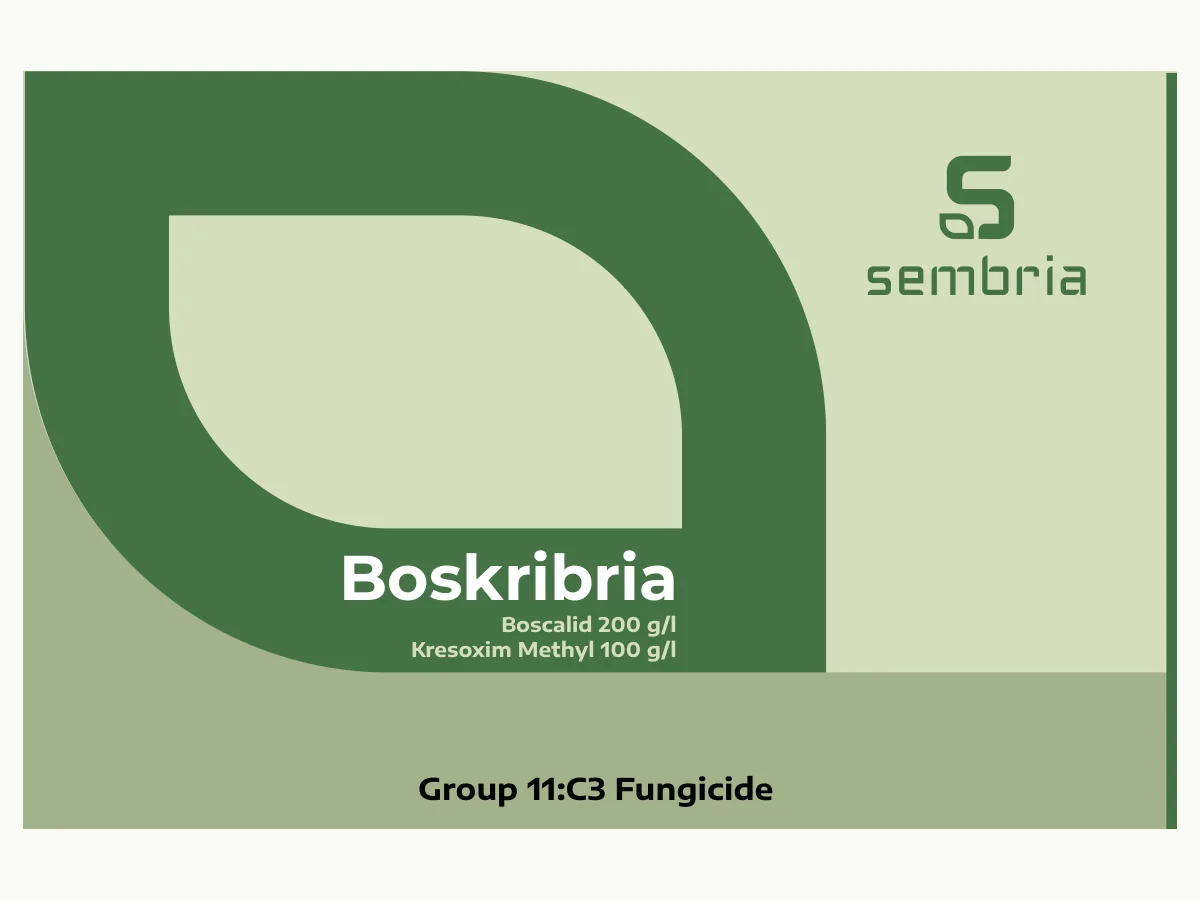
Boskribria pairs boscalid with kresoxim-methyl — an SDHI and a strobilurin — in a single suspension concentrate aimed at powdery mildew. Both actives attack the fungus's energy production, but at different points in the respiratory chain, so the pathogen has to overcome two independent targets at once. That is what makes a built-in mixture worth more than the sum of its parts: it delivers control today and protects the usefulness of both chemistries for future seasons.
Characteristics
- Two complementary modes of action in one product — built-in resistance management
- Protective and curative activity against powdery mildew
- Registered on vine, greenhouse tomato and pepper, and cantaloupe
- Three-day pre-harvest interval on greenhouse vegetables
- Kresoxim-methyl also delivers the strobilurin greening effect on leaf tissue
- FRAC Groups 7 and 11
How it works
Boscalid inhibits succinate dehydrogenase (complex II) and kresoxim-methyl inhibits the cytochrome bc1 complex (complex III) — two separate steps of fungal mitochondrial respiration. Deprived of ATP, spore germination and germ tube growth stop, and established mycelium cannot continue to develop. FRAC Group 7 (SDHI) + Group 11 (QoI).
Dosing
| Crop | Target disease | Dose | PHI (days) |
|---|---|---|---|
| Vine | Powdery mildew (Erysiphe necator) | 30 ml/100 L water | 28 |
| Pepper (greenhouse) | Powdery mildew on Solanaceae (Leveillula taurica) | 50 ml/100 L water | 3 |
| Tomato (greenhouse) | Powdery mildew on Solanaceae (Leveillula taurica) | 50 ml/100 L water | 3 |
| Cantaloupe | Powdery mildew on Cucurbitaceae (Erysiphe cichoracearum, Sphaerotheca fuliginea) | 50 ml/ha | 3 |
Doses are indicative. The user is responsible for adjusting the dose to the growth stage of the crop and the conditions of the field. Apply under the guidance of an agricultural technician. Composition, method of application and dose may vary between countries for climatic, technical or legal reasons.
Application
How to apply
Vine: first application when shoots reach 25-30 cm (varies by region); second at petal fall; further applications through to the grain-drop period depending on how long the second holds. Greenhouse tomato: begin before or as buds open, then weekly according to disease pressure — up to six applications, or more if the disease persists; usually applications can stop once fruits reach hazelnut size, with one more pass in August when new shoots start. Greenhouse pepper: begin at the first visible symptoms. Cantaloupe: start at first symptoms, then 2-5 sprays at 10-day intervals (systemics every 15 days). Pause applications when the daily mean exceeds 27 C and relative humidity falls below 50%. Shake well before use.
Compatibility
Conduct a pre-mix compatibility test. Use mixtures immediately after preparation. Do not store below -5 C or above +35 C.
Always carry out a compatibility test before preparing a tank mixture.
Safety and handling
Causes skin irritation. Very toxic to aquatic life with long-lasting effects. Toxic to fish and to bees — do not apply during flowering, avoid contaminating groundwater and surface water. Do not re-enter the treated area for 1 day. Wear gloves, protective clothing and eye protection.
Read the label before use. Do not use at home. Keep away from children, food and animal feed. Use only as recommended and at the recommended dose.
Plant protection product
This page is technical information, not an offer of sale. Availability and registration status vary by territory. Always read and follow the approved product label before use.